

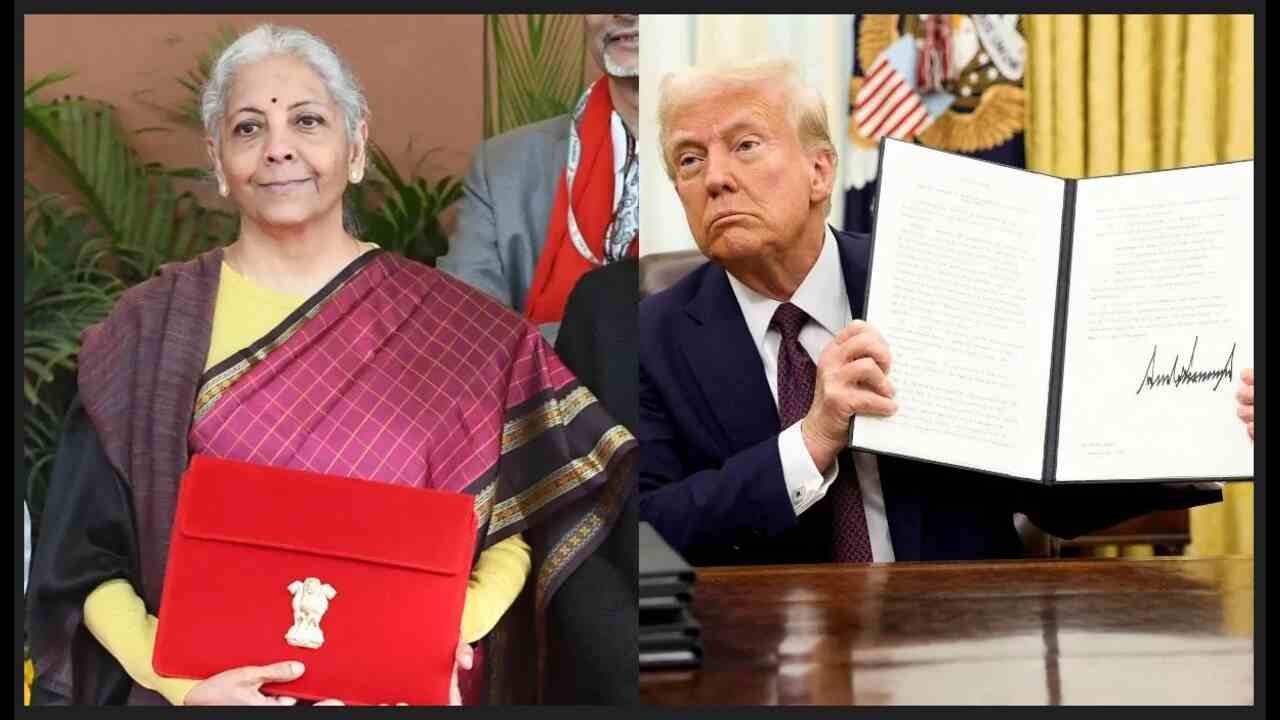
Trump Tariffs and Budget 2026: Union Finance Minister Nirmala Sitharaman has presented the Union Budget 2026–27 in Parliament. As soon as the Budget was unveiled, it became clear that this is not merely a statement of income and expenditure. It also lays out India’s economic strategy in a rapidly changing global environment—especially amid the United States’ tougher trade stance.
High tariffs imposed by former US President Donald Trump, uncertainty around an India–US trade deal, and duties running as high as 50% had put several of India’s labour-intensive sectors under severe pressure. Against this backdrop, expectations from Budget 2026 were high—and to a considerable extent, those expectations appear to have been met.
Table of Contents
ToggleSEZs Hit Hard by Trump Tariffs
Over the past few months, US tariffs have deepened the crisis for India’s export-oriented industries, particularly textiles, apparel, leather, footwear and seafood. Many Special Economic Zone (SEZ) units dependent on the US market saw orders dry up, production stall, and jobs come under direct threat.
The situation became so serious that over the last five years, 466 units across seven SEZs have shut down. India also recorded a decline in merchandise exports for two consecutive months—September and October—further heightening the government’s concerns.
Budget Relief for SEZs
Against this backdrop, one of the most significant and strategic announcements in Budget 2026 is relief for SEZs. The Finance Minister announced a special, one-time provision allowing eligible SEZ manufacturing units to sell their products in the Domestic Tariff Area (DTA) at concessional customs duties.
The aim is to give breathing space to units whose production capacities have remained underutilised due to disruptions in global trade. The government also clarified that necessary regulatory changes will be introduced to maintain a level playing field with domestic units.
India currently has 370 SEZs employing over 3.1 million people. This decision is therefore being seen as crucial for safeguarding millions of jobs.
Textiles: Another Major Casualty of Trump Tariffs
Budget 2026’s strong focus on the textile sector is also part of the strategy to offset the impact of US tariffs. Often described as the backbone of India’s economy, the textile and apparel industry was among the worst affected, with several exporters even losing summer orders.
To address this, the government has announced an integrated programme aimed at modernising the entire textile supply chain. Under the National Fibre Scheme, emphasis will be placed on self-reliance in silk, wool, jute, man-made and next-generation fibres.
Traditional textile clusters will receive capital support for advanced machinery, technology upgrades, and access to common testing and certification centres. The government believes these measures will help Indian textile producers regain competitiveness in global markets.
Why the Textile Sector Matters
The importance of textiles is evident from the fact that it contributes 13% to industrial production, 12% to exports, and around 2% to India’s GDP. Nearly 80% of its value chain is concentrated in MSME clusters, which are major employment generators.
Had the sector weakened further due to US tariffs, the impact would have been felt directly on jobs and the rural economy. Budget 2026’s provisions are clearly aimed at mitigating this risk.
Simplified Duty Structure for Labour-Intensive Sectors
The government has also taken steps to simplify the duty structure for labour-intensive sectors. For seafood exports, the limit for duty-free inputs has been increased to 3% of the previous year’s export turnover.
Duty-free input benefits have also been extended to footwear uppers, which were earlier limited to leather and synthetic footwear. Additionally, the export obligation period for leather, textile garments and footwear exporters has been extended from six months to one year.
The objective is straightforward: reduce costs for Indian exporters and help them remain competitive globally.
Container Manufacturing: Reducing Strategic Dependence
Another key announcement in Budget 2026 relates to container manufacturing. In recent years, container shortages have emerged as a major challenge in global trade, worsened by the Red Sea crisis and rising tensions in the Middle East.
India has so far been heavily dependent on China, which produces nearly 95% of the world’s containers. Viewing this as a strategic risk, the government has announced a ₹10,000-crore container manufacturing scheme for five years. The goal is to build a competitive domestic ecosystem and strengthen supply-chain self-reliance.
At a Glance
In short, Budget 2026 goes beyond domestic priorities. It clearly signals that the government has drawn lessons from Trump-era tariffs and global trade volatility. Relief for SEZs, strong support for textiles and MSMEs, cost-cutting measures for exporters, and the push for container manufacturing all indicate that India is choosing a strategic—not defensive—approach to global challenges.
While the real impact will depend on swift implementation, there is little doubt that Budget 2026 marks a solid beginning in cushioning the Indian economy against the effects of Trump tariffs.